
 Available in US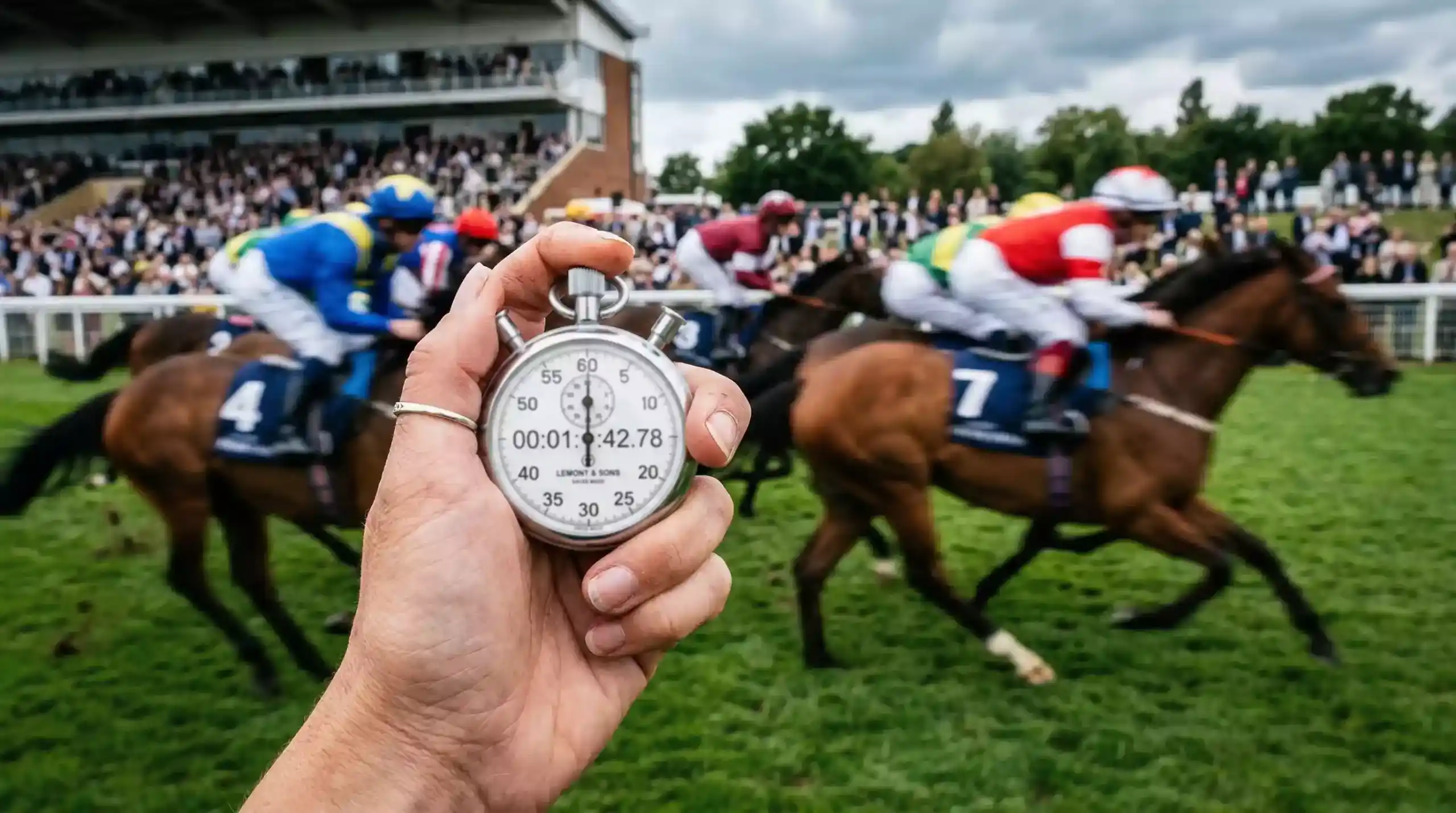
The clock doesn’t lie. While subjective assessments of racing style and visual impression can mislead, times provide objective evidence of how fast horses actually ran. Speed figures translate raw times into comparable metrics, accounting for track conditions, distances, and race circumstances. This objectivity creates analytical edge over punters relying solely on visual form assessment.
British racing maintains 1,423 Flat horses rated 90 or above—elite performers whose speed capabilities are well-documented through rigorous timing analysis. Understanding how speed data works, what Timeform ratings represent, and how modern sectional timing reveals hidden information transforms raw numbers into betting advantage. Speed analysis complements traditional form study rather than replacing it, adding another dimension to race assessment.
What Speed Figures Measure
Raw race times tell you how long a horse took to complete a distance—but without context, this information has limited value. A horse winning in 1:24 over seven furlongs might have run brilliantly on heavy ground or slowly on fast ground. Speed figures adjust for these variables, producing comparable metrics across different conditions.
Track variants account for going conditions. Compilers calculate how fast or slow the track is running compared to standard times, then adjust individual race times accordingly. A time one second slower than standard on a track running two seconds slow actually represents a time one second faster than standard—impressive rather than ordinary.
Weight carried affects speed. Horses carrying more weight run slower than they would under lighter burdens. Speed figures often adjust for weight, enabling comparison between horses carrying different loads. This adjustment reveals whether a horse giving weight actually ran faster than rivals conceding it—information winning margins don’t immediately convey.
Wind conditions influence times significantly. Headwinds slow horses; tailwinds help them. Sophisticated speed figure systems account for wind speed and direction, recognising that a fast time into a headwind represents greater ability than the same time with wind assistance.
Ground variation within races complicates analysis. Different parts of the track might ride faster or slower—inside rail versus centre course, for instance. Horses taking different routes experience different effective going conditions, making direct time comparison imperfect. Quality speed figures attempt to account for these nuances where data permits.
Speed Figures in UK Racing — More on this topic at horse racing betting tips.
Timeform Ratings Explained
Timeform ratings represent the industry standard for assessing horse ability in Britain. Established in 1948, Timeform combines speed figures with form analysis to produce ratings expressed in pounds—a 120-rated horse theoretically carries 10lb more ability than a 110-rated horse.
The rating scale runs from approximately 20 for the weakest horses to around 140 for exceptional champions. Most handicappers rate between 45 and 105; horses rated above 110 compete in Group races. Understanding where ratings sit within this distribution contextualises individual assessments.
Timeform ratings incorporate race-by-race adjustments. After each performance, horses earn figures reflecting that specific run. These individual figures might exceed or fall below the master rating, indicating improving or declining form. A horse rated 95 who achieves a 102 figure is progressing; one achieving only 88 is regressing.
Symbols complement numerical ratings. Letters indicate particular characteristics: ‘p’ suggests improvement likely; ‘d’ indicates the horse is unreliable; ‘h’ denotes a horse who acts on hard ground. These qualitative additions help interpret raw numbers in context.
The proportion of top-rated horses trained in Great Britain has increased from 12% in 2013 to 17% in 2021, reflecting the concentration of quality at British training centres. Understanding rating distributions across regions helps contextualise how British-trained horses compare internationally.
Timeform ratings are proprietary—access requires subscription or purchase. Cheaper alternatives exist but typically offer less rigorous methodology. Consider whether investment in quality ratings data suits your betting volume and approach.
Sectional Times: The Modern Edge
Sectional timing measures how fast horses run different portions of a race—typically furlong-by-furlong or in larger segments. This data reveals what overall times cannot: how races developed, where horses gained or lost ground, and which horses finished strongest.
Closing sectionals identify horses with untapped ability. A horse recording a fast final two furlongs despite finishing mid-division ran faster at the end than horses ahead of it. Given a different pace scenario or better positioning, that horse might win. Closing sectionals reveal potential that results disguise.
Early pace analysis identifies setup requirements. Some horses need strong early fractions to enable their closing kick; others prefer slow early pace to conserve energy. Matching likely pace scenarios to individual running styles helps predict which horses benefit from anticipated conditions.
Track-specific sectional standards enable comparison. A final furlong in 11.5 seconds might be excellent at one track and ordinary at another depending on terrain and configuration. Quality sectional analysis adjusts for track characteristics just as overall speed figures adjust for going.
Sectional data availability has improved dramatically. Where once only major meetings produced reliable sectionals, many UK courses now provide data through partnerships with timing companies. This democratisation enables wider use of sectional analysis, though data quality still varies.
Combining sectionals with overall speed figures produces richer analysis than either alone. A horse with strong overall figure and fast closing sectional represents quality with potential; one with modest overall figure but blistering close shows ability compromised by circumstances. Both observations inform betting differently.
See also Novice Chases Explained.
Applying Speed Data to Your Bets
Identify races where speed figures clearly separate contenders. When one horse’s best figure exceeds rivals’ by significant margin—five or more pounds on Timeform scale—speed analysis provides strong direction. Closer competitions require additional factors beyond pure speed assessment.
Weight recent figures more heavily than older ones. Horses improve and decline; a figure from six months ago might no longer represent current ability. Focus on last three to five runs for Flat horses, acknowledging that consistent performers merit confidence while volatile ones carry uncertainty.
Use sectionals to assess beaten horses. A horse finishing fourth but recording fastest closing sectional might have been unlucky—worthy of following next time despite the defeat. Conversely, a winner with slow sectionals relative to placed horses might have been flattered by circumstances.
Recognise limitations. Speed figures work best on Flat racing over standard distances on conventional courses. Jumps racing involves more variables; unusual track configurations complicate comparisons. Apply speed analysis where it works well rather than forcing it onto unsuitable situations.
Compare figures at class level. A horse achieving high figure in a Class 5 handicap might struggle to replicate that performance in Class 3 company—quicker pace, better rivals, different tactical demands all affect speed output. Context matters alongside raw numbers.
Track improving horses through progressive figures. A sequence of 75-80-85-88 suggests genuine improvement; a sequence of 75-82-74-80 suggests inconsistency. The trajectory tells stories that single figures cannot.
The Clock Doesn’t Lie
Speed figures provide objective performance measurement that complements subjective form assessment. Understanding adjustments for going, weight, and wind conditions enables meaningful comparison across different races and circumstances. Timeform ratings offer industry-standard benchmarks, while sectional timing reveals hidden ability that overall times miss—identifying horses who ran faster than finishing positions suggest. Applying speed data requires recognising where it works best—Flat racing on conventional courses—while maintaining realistic expectations about its limitations in jumps racing and unusual configurations. Combining speed analysis with traditional form study creates more complete race pictures than either approach alone, adding analytical edge that visual assessment cannot provide.
