
 Available in US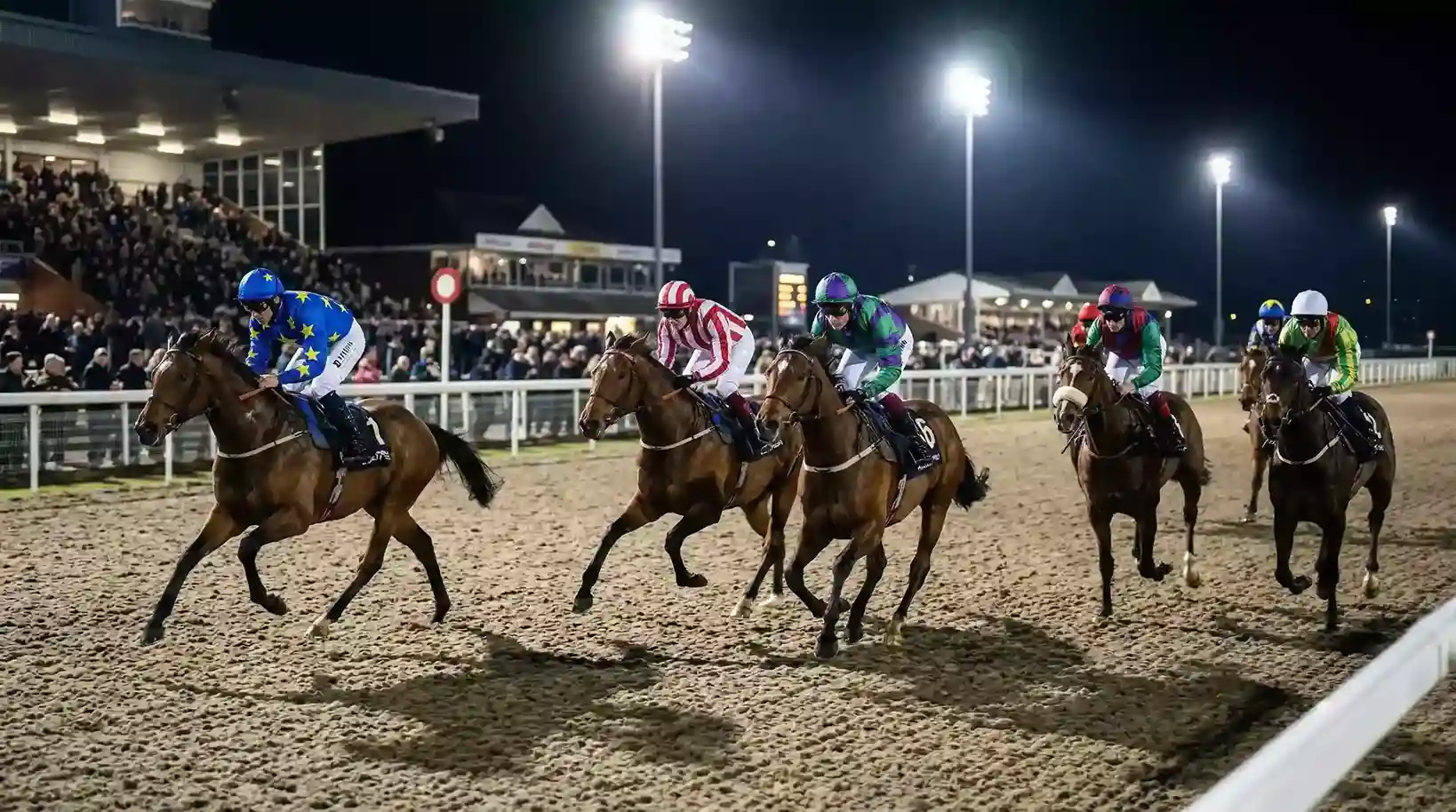
Racing without the rain. All-weather tracks provide year-round racing regardless of conditions that close turf courses. While traditionalists once dismissed synthetic surfaces as inferior, all-weather racing now hosts significant prize money, competitive fields, and genuine betting opportunities. The 2024 calendar saw 78 full or partial fixture abandonments on turf—all-weather meetings continued regardless, providing punters with consistent action.
Understanding all-weather racing requires recognising its distinct characteristics. Different surfaces suit different horses. Track configurations create their own biases. Form on synthetic surfaces often doesn’t translate to turf—and vice versa. Approaching all-weather betting with turf-racing assumptions produces poor results; treating it as a separate discipline enables profitable specialisation throughout the calendar year.
UK All-Weather Tracks Explained
Six all-weather tracks operate in Britain: Kempton Park, Lingfield Park, Southwell, Wolverhampton, Newcastle, and Chelmsford City. Each offers year-round flat racing unaffected by weather that closes turf venues. Together they host hundreds of meetings annually, maintaining racing calendars through winter months when turf racing diminishes.
Kempton Park runs right-handed over a sharp triangular mile. The configuration suits handy, adaptable horses rather than long-striding gallopers. Races often develop into tactical affairs where positioning and race tempo determine outcomes more than pure speed.
Lingfield Park offers left-handed racing on a tight circuit. The turns come quickly; horses must handle bends without losing momentum. Front-runners can dominate if establishing position early; closers sometimes struggle to accelerate through traffic on the tight turns.
Wolverhampton’s Dunstall Park hosts evening and twilight meetings throughout the year. The left-handed track features a galloping layout suited to horses who travel strongly. Long straights allow closers to challenge; the configuration rewards stamina alongside speed.
Newcastle’s Gosforth Park provides the largest all-weather track—a left-handed circuit with a genuine galloping layout. Horses with less tactical pace find opportunities here that tighter tracks don’t allow. The track’s scale creates different dynamics than smaller venues.
Southwell and Chelmsford City complete the roster, each with distinctive characteristics. Southwell’s fibresand surface differs significantly from other venues; Chelmsford’s modern Polytrack suits horses who handle that specific surface.
Meeting timing affects competition quality. Evening meetings at Wolverhampton attract different fields than afternoon cards elsewhere. Twilight slots, daytime fixtures, and weekend meetings each draw particular types of runners and connections.
All-Weather Racing UK — More on this topic at horse racing betting tips.
Surface Differences: Polytrack, Fibresand & Tapeta
All-weather surfaces differ substantially despite sharing the synthetic classification. Polytrack—used at Kempton, Lingfield, and Chelmsford—combines sand with synthetic fibres and wax coating. The surface typically rides fast, producing quick times and favouring horses with natural speed.
Tapeta at Newcastle and Wolverhampton offers different characteristics. This surface often produces more consistent racing with less variation between meeting conditions. Horses who handle Tapeta sometimes struggle on Polytrack, and vice versa—the surfaces feel different underfoot despite superficial similarity.
Southwell’s fibresand stands apart. The deeper, more demanding surface tests stamina more severely than Polytrack or Tapeta. Horses who stay well often outperform their turf ratings at Southwell; pure speed horses sometimes struggle with the demanding kickback. Fibresand specialists exist who rarely reproduce their Southwell form elsewhere.
Surface preferences develop through experience. A horse’s first runs on synthetic tracks reveal aptitude—or lack thereof. Subsequent runs on the same surface type provide evidence of genuine preference rather than one-off adjustment. Track consistent runners whose form on one surface exceeds form elsewhere represent the clearest specialists.
Surface changes affect historical comparison. When tracks change surface type—as several have—older form becomes less relevant. Check when surfaces were installed before using historical form that predates current configurations. A horse’s record at a track might span two different surfaces with entirely different suitability implications.
Identifying All-Weather Specialists
All-weather specialists produce their best form on synthetic surfaces, often substantially exceeding their turf performances. These horses offer value when competing on favoured surfaces against rivals without proven synthetic aptitude.
Course form provides the strongest evidence. A horse winning three times at Wolverhampton demonstrates proven aptitude regardless of turf form. Repeat visits to the same track with consistent placing indicate specialist status. Weight course-specific form heavily when assessing all-weather races.
Trainer patterns reveal surface preferences. Some trainers target all-weather campaigns specifically, developing strings of horses suited to synthetic surfaces. Others treat all-weather racing as a supplement to turf programmes. Trainers with strong all-weather records deserve respect when sending runners to favoured venues.
Pedigree provides modest guidance. Some sire lines produce synthetic-surface aptitude more consistently than others, though individual variation exceeds genetic generalisation. Pedigree hints rather than determines; actual race performance confirms or refutes breeding suggestions.
Horses dropping from turf to all-weather sometimes improve—or disappoint. Those whose turf form suggests limitations—perhaps lacking acceleration on fast ground—might handle synthetic surfaces better. Others who thrived on turf struggle with different kickback and surface feel. Early all-weather runs reveal which category applies.
Track-to-track transfers within all-weather aren’t automatic. A Kempton specialist might struggle at Newcastle’s galloping track. Surface type matters—Polytrack horses don’t always handle Tapeta—but so does configuration. Assess track-specific form rather than generalising across all synthetic venues.
See also Two-Year-Old Racing.
All-Weather Form Analysis
Separate all-weather form from turf form in your analysis. A horse with a turf rating of 85 who achieves 75 on all-weather represents a 75-rated all-weather performer, not an 85-rated horse having a bad day. Maintain mental separation between surface performances.
Recent all-weather form outweighs older turf form. A horse last seen finishing mid-division on turf six months ago who has since won twice on all-weather deserves assessment as a winning all-weather performer. The intervening synthetic form tells you more than the dated turf run.
Draw bias affects all-weather tracks significantly. Tight turns and narrow straights create positional advantages. Some tracks favour low draws; others favour high. Study draw statistics for each track at different distances—patterns often emerge that casual analysis misses.
Pace analysis matters particularly on all-weather. Without going variations to explain results, race tempo becomes more significant. Front-runners on slow-pace days; closers on fast-pace days. Identifying likely pace scenarios for each race helps predict which running styles benefit.
Class indicators function differently. All-weather handicaps sometimes attract horses whose turf marks exceed their synthetic ability—or vice versa. A horse dropping from turf Class 3 to all-weather Class 4 might not actually be dropping in competitive terms if its synthetic form sits below its turf rating.
Winter all-weather campaigns create form clusters. Horses competing regularly through winter months generate substantial recent form on synthetic surfaces. This concentration of evidence makes winter all-weather form particularly useful for assessment compared to sporadic turf campaigns.
Prize money on all-weather has grown considerably. Major all-weather championships and valuable handicaps now attract competitive fields. Don’t dismiss all-weather racing as low-grade filler—significant opportunities exist at higher levels.
Racing Without the Rain
All-weather racing demands treatment as a distinct discipline rather than inferior turf substitute. Six UK tracks offer different configurations and surfaces—Polytrack, Tapeta, and fibresand each suit different horses with distinct preferences that rarely transfer between surface types. Identifying specialists whose synthetic form exceeds turf performances creates value opportunities that markets might miss. Separating all-weather form from turf form, recognising draw biases specific to each track, and analysing pace scenarios specifically for synthetic racing produces better results than applying turf-racing frameworks inappropriately. Year-round availability means all-weather proficiency offers consistent betting opportunities when turf racing diminishes during winter months and abandonments mount.
